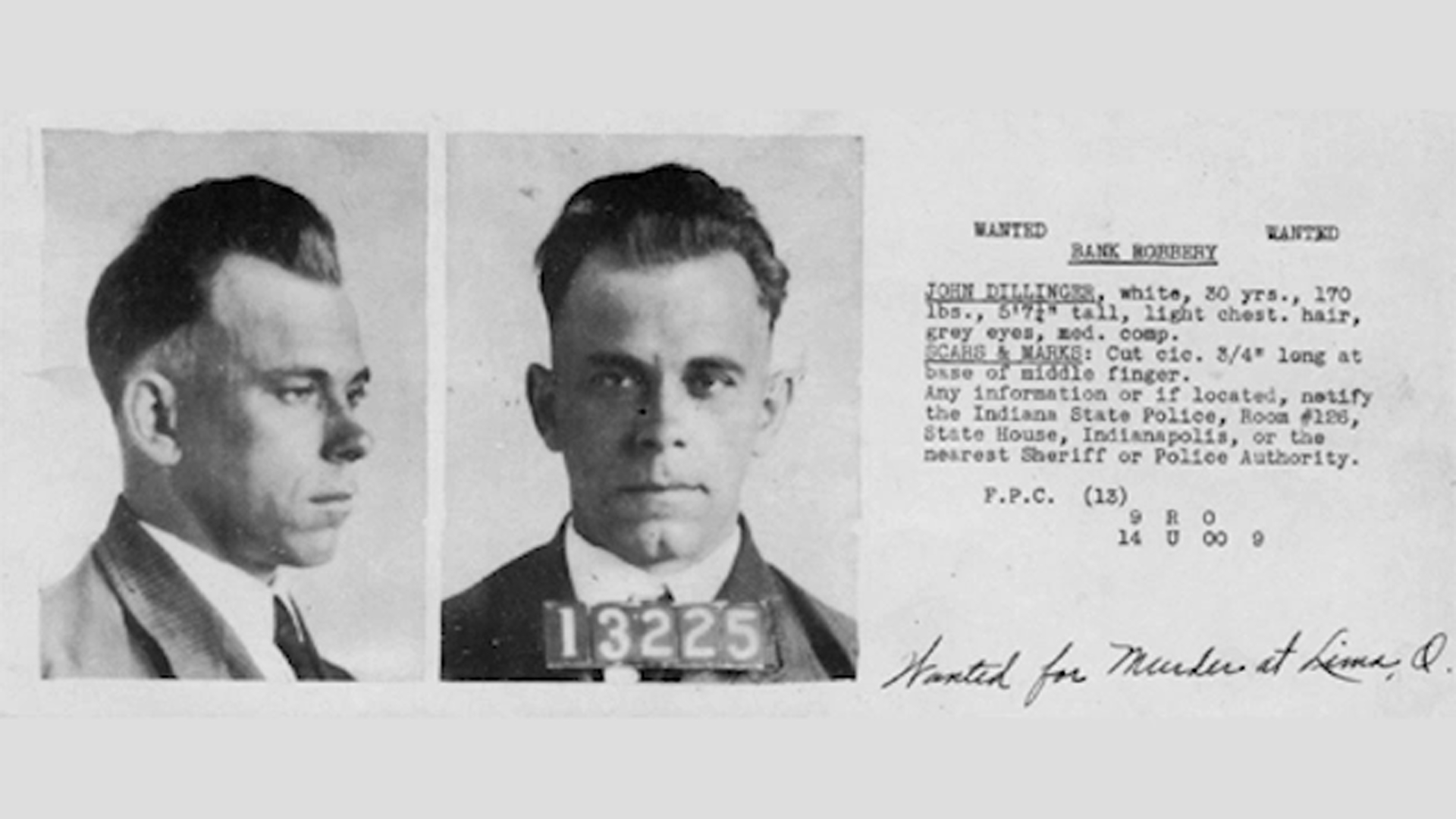
92 years since John Dillinger killed by federal agents outside Chicago theater


CHICAGO (WLS) -- John Herbert Dillinger was shot and killed by federal agents outside Chicago's Biograph Theatre on July 22, 1934. He was an infamous bank robber.
The FBI says he "evoked a Gangster Era and stirred mass emotion to a degree rarely seen in this country."
From September 1933 until his death, the FBI says he and his gang "terrorized" the Midwest. Ten men were killed, seven were wounded; the gang was known for robbing banks and police arsenals, and staging three jail breaks. One of the jail breaks ended wit a dead sheriff and two wounded guards, the FBI said.
On Saturday, July 21, 1934, Ana Cumpanas, a madam of a brothel, contacted police saying that one of her friends, Polly Hamilton, had visited her business with Dillinger.
Cumpanas told agents her plans to meet up with her friend and Dillinger, in exchange for a cash reward and help to prevent her deportation, according to the FBI.
Agents made the agreement and learned the plan. They showed up to Chicago's Biograph Theater at 2433 N. Lincoln Avenue where Dillinger had just seen the Clark Gable movie "Manhattan Melodrama."
Three FBI agents shot at him as he exited the theater. Dillinger was pronounced dead in the Alexian Brothers Hospital at 10:50 p.m.
The FBI calls his death "the beginning of the end of the Gangster Era" in Chicago.
The video in the player above is from a related report.

RELATED | Will gangster John Dillinger's bones stay undisturbed after kin drop exhumation lawsuit?
A notorious conspiracy theory suggests that federal investigators were so hungry to lower the curtain on Dillinger that they shot and killed another man, whose remains have been buried in the grave for decades.
Cook County morgue and FBI officials have denied such allegations and have said that incontrovertible evidence proves it was -- and is -- Dillinger.
In 2019, Dillinger family members sued Crown Hill Cemetery and wanted the remains for DNA testing to determine whether it was an imposter corpse, as they seemed to believe.
After about a year, Dillinger's nephew Michael Thompson pulled the plug on the lawsuit.
Thompson filed a motion to dismiss his own case, with the caveat that he could refile in the future.