WNBA's future is bright, but will Cathy Engelbert be there to lead it?

In the darkest days of the past 12 months, full of public vitriol and a contentious labor negotiation, Cathy Engelbert leaned on teachings and advice she had gathered over 40-plus years in corporate America. One leader who has stuck with her for more than a decade is retired four-star admiral Bill McRaven, who went viral for a 2014 commencement address at the University of Texas where he shared life lessons from his Navy SEAL training.
McRaven's most well-known piece of advice is "If you want to change the world, start off by making your bed." But Engelbert focused on another teaching from McRaven.
"It's easy to lead in good times," Engelbert told ESPN in a phone interview last week. "Where leaders really emerge in my experience ... is when you're your best in your darkest moments, and you don't give up."
Engelbert has navigated numerous challenges in her seven years as WNBA commissioner, from two collective bargaining negotiations to a global pandemic and social unrest to inheriting a business with, in her words, "no money, no scale, no capability."
Yet, she might be living the darkest moments of her tenure now.
A tempest surrounding her leadership emerged last fall when Napheesa Collier, one of the league's biggest stars, said in an explosive end-of-season interview that Engelbert was "negligent" in her governance and that the WNBA had the "worst leadership in the world."
Nearly 10 months later, what should be a celebratory summer of the league's 30th season, of the W's brilliant star power, and of making it through strenuous labor negotiations with a historic agreement, has instead felt like one of exasperation.
Players, teams and fans consistently -- and loudly -- voice frustrations over officiating, and divisive discourse and increased harassment toward players seem never-ending. An in-game incident last month when Phoenix Mercury forward Alyssa Thomas pushed her fist onto Indiana Fever guard Caitlin Clark's throat especially galvanized fans and critics.
Even the league's retroactive assessment of Thomas getting a flagrant 2 foul and one-game suspension turned into a spectacle: Reports said NBA commissioner Adam Silver stepped in to advise Engelbert that Thomas should be suspended; Thomas, who said the play was "a complete accident" and cited harassment and death threats in the days after, called out Engelbert for "remain[ing] silent." Two weeks later, a group of Congressional Republicans sent a letter to Engelbert demanding "accountability" for "multiple attacks" on Clark, who's increasingly become a political lightning rod.
All of it, plus Engelbert's perceived absence publicly and in league circles, has renewed the referendum on her leadership.
"Here we are with all this stuff that's happened," one team executive told ESPN, "and it just, at different points, has felt like, 'Where are you?'"
Conversations with more than 20 stakeholders in and around the WNBA who spoke on the condition of anonymity, including owners, management, players and other industry insiders, offer a general belief that for as much business growth Engelbert has overseen, she's not the right person to navigate the demands the league currently faces and what its stakeholders now need.
"I do think Cathy thinks, well, she's done her job. She got us financially set up the right way," another team executive said. "It's the other pieces that we're talking about."
Multiple high-ranking team sources told ESPN they believe the 2026 season likely will be Engelbert's last.
"The hole has just gotten so deep," said Jeff Hunt, a specialist in crisis and reputation management who has previously worked with MLB, ATP, WTA and the PGA Tour. "She's in a place now where I don't really know what she does."
Engelbert has deflected questions about her future as commissioner, including those from ESPN last week.
"I'm focused head-down on executing this highly, highly successful 30th season," Engelbert said. "I love this league. We're going to continue to drive the business. And don't worry about me. It's more about the team ... that's what we've built here at the W. So, I'm really, really optimistic about where we're going in the future."
The question is whether she'll be part of it.
IN MAY 2019, when Engelbert was named the first commissioner of the WNBA -- the title for former leaders was "president" -- Silver lauded the 33-year Deloitte professional and former CEO as a "world-class business leader" who could bring "revenue generation, sharp entrepreneurial instincts and proven management abilities."
When the COVID-19 pandemic -- an "existential" moment for the league, as she has called it -- hit less than a year into the job, Engelbert marshaled the WNBA to successfully execute a condensed "bubble" season.
In the years since, the WNBA has catapulted into what Engelbert calls "hypergrowth" mode, cementing itself as a major sports and entertainment property. The WNBA's new media rights deals are worth $3.1 billion, and league revenue has grown almost 10-fold. A wave of expansion will see the league reach 18 markets by 2030 after nearly two decades of stagnation at 12 teams. The season footprint will soon increase to 50 games, up from 34 when Engelbert took over.
Internal change was just as profound: The size of the league office increased from 12 dedicated employees to approximately 85, Engelbert said, which included hiring the league's first chief marketing and chief growth officers.
And most significantly, a transformational CBA recently negotiated with the Women's National Basketball Players Association secured the first $1 million salaries as well as the first comprehensive revenue-sharing model in women's professional sports.
Yet, missteps dotted her tenure. In 2024, she did not condemn racist and vitriolic behavior from fans surrounding the Caitlin Clark-Angel Reese rivalry in a CNBC interview. But Collier's scorched-earth remarks -- and the slew of player support she received in the aftermath -- marked the first time Engelbert's strained relationships around the league erupted publicly.
At the time, Engelbert said she felt "disheartened" to hear some players felt she and the league did not care about them and that if they do feel that way, "then we have to do better and I have to do better ... if there's things we need to fix, we're going to fix them."
The CBA negotiations were contentious, but the final product was viewed as a win for both sides and seemed to at least temporarily patch up matters. "Kudos to Cathy," Liberty forward Satou Sabally, a member of the WNBPA's CBA committee, said in April. "She really wanted to make a new CBA work. She did it. It was transformational like she promised it would be."
WNBPA president Nneka Ogwumike told CNBC in March that she had said to Engelbert, "We're standing here with you, Cathy ... there probably isn't a better way to represent us settling our differences and moving forward in a league that we all care about than by signing this deal."
At the WNBA draft on April 13, Engelbert said she felt "really good" about her relationship with players, suggesting their previous criticisms were "a lot of posturing" amid negotiations, a sentiment she echoed last week to ESPN.
"I think it was a moment of maturity to say, 'Yeah, [the negotiation] was contentious.' So was the NBA one, the NFL one, the Major League Baseball one," Engelbert said. "We never had one like that. Was there a lot of posturing? Sure. Was there a lot of discussion back and forth? I see what Rob Manfred's going to go through in MLB. This is just unfortunately the way it is.
"There was a lot going on in between, but I'm really proud of what we did together with the players, so utmost respect for them."
Even so, the league remains unsettled.
ARGUABLY THE MOST magical moment of the 2026 season occurred June 21, when Ogwumike hit a buzzer-beating 3-pointer to secure the Los Angeles Sparks' win against the Liberty in a matchup scheduled to commemorate the league's inaugural game on the same date in 1997.
Over 18,000 fans were in attendance, including WNBA legends Lisa Leslie, Teresa Weatherspoon and Rebecca Lobo, who had played in the inaugural game.
Engelbert missed the celebratory game -- she was about 3,000 miles away in Southampton, New York, for the U.S. Open golf tournament. A member of the 15-person USGA executive committee, she presented a trophy that evening to champion Wyndham Clark's caddie.
She also did not appear later that week at the Women's Basketball Hall of Fame induction in Knoxville, Tennessee, where Lynx coach Cheryl Reeve and league legends Candace Parker and Elena Delle Donne were honored.
A source familiar with the situation told ESPN that Engelbert was required to attend the U.S. Open as a member of the organization's executive committee, and that she had a personal family commitment the day of the WBHOF induction. Yet, people in and around the league noticed her absence.

Nine months after vowing to address any concerns with leadership, sources leaguewide said Engelbert has failed to develop sufficient relationship equity, not just among players but also owners and upper-level management.
"I don't see any change [since Collier's comments]," one owner told ESPN. "I don't think she's learned significantly based on her failures."
Stakeholders from multiple constituencies across the league -- team officials, owners, players and agents -- cite Engelbert's style and approach as problematic, saying she often comes across as "not personable," "defensive," "dismissive," "condescending," or "out of touch," while others believe accessibility, communication, transparency and synergy between the league and teams are persistent hurdles.
After the incident with Clark, Thomas said she received death threats and had been called racial slurs but never heard anything from the commissioner. Engelbert told ESPN that she has offered to meet with Thomas, saying she has an "open-door policy" for all players. But multiple people close to the situation said Thomas and Engelbert still haven't talked.
"If anything, I feel like things have gotten more rough," one player told ESPN.
Multiple longtime team officials suggested the league hire someone -- under Engelbert or the next commissioner -- in the mold of former chief of basketball operations and player relations Renee Brown, who served as a bridge between the league office and its teams and players. Brown left in 2016, before Engelbert took over, and officials said that connection has been missing since her departure.
"When [people] see your face on a regular basis, they know you're in it with them," one team executive said. "And I think we lack that [from league leadership]."
Multiple team sources told ESPN that they find it curious Engelbert hasn't prioritized developing a closer relationship with Clark, the league's most high-profile player and the one widely credited with helping supercharge the league's popularity; Silver, meanwhile, touted this week at the CNBC Sport x Boardroom Game Plan Summit that "I have come to know Caitlin really well. She's an incredible player and also an incredible person."
After the Clark-Thomas incident, player leadership requested a meeting with Engelbert to address online harassment, security and officiating; players on the call told reporters that Engelbert was receptive to their feedback in the meeting Tuesday and acknowledged communication between the players and the league could be better.
In her interview with ESPN, Engelbert condemned the racism, sexism, homophobia and threats players face as "unacceptable" and "disgusting" before outlining the tenets of the league's No Space For Hate platform that debuted heading into the 2025 season: enhanced security measures, reinforcing mental health resources and using technology to protect players from hateful comments.
Frustrations also have mounted with what many believe is a reactive approach from the league in responding to emerging crises or moments that could develop into them. And some team and player sources have expressed concern over whether the toxic rhetoric, which the league has struggled to squash, is impacting the WNBA's optics and brand.
"This situation is deteriorating reputational equity," Hunt said. "The brand is under fire, and it's going to remain under fire until they figure out a way to get out of this hole."
As part of her annual midseason news conference, Engelbert will speak to reporters Saturday before the All-Star Game in Chicago. But she has faced criticism over not being more available to the media. The week that Engelbert was sent the Congressional letter -- to which a source told ESPN the league has since responded -- radio personality Dan Patrick criticized her for agreeing to an interview while participating at the American Championship celebrity golf tournament and then no-showing. Reporters who requested to speak with her in-person at the Commissioner's Cup championship game -- the same day Thomas denounced Engelbert publicly -- were instead provided a four-sentence statement responding to Thomas.
Bunkering, Hunt said, is a natural tendency when leaders are faced with scrutiny, but it almost never works.
"There's a natural vacuum that gets opened when a crisis occurs, and it's going to get filled by you, or it gets filled by speculation, innuendo, people that have ulterior agendas and motives, and so I think that's what's happened to her," he said. "She's not really seized the narrative."
And beyond the outside stakeholders, the rest of the league has been watching and waiting.
"Sometimes, leadership calls for you to step forward," a team executive said. "You have to have a pulse on what is happening and have enough emotional intelligence to understand when is the time to step forward, and when enough is enough."
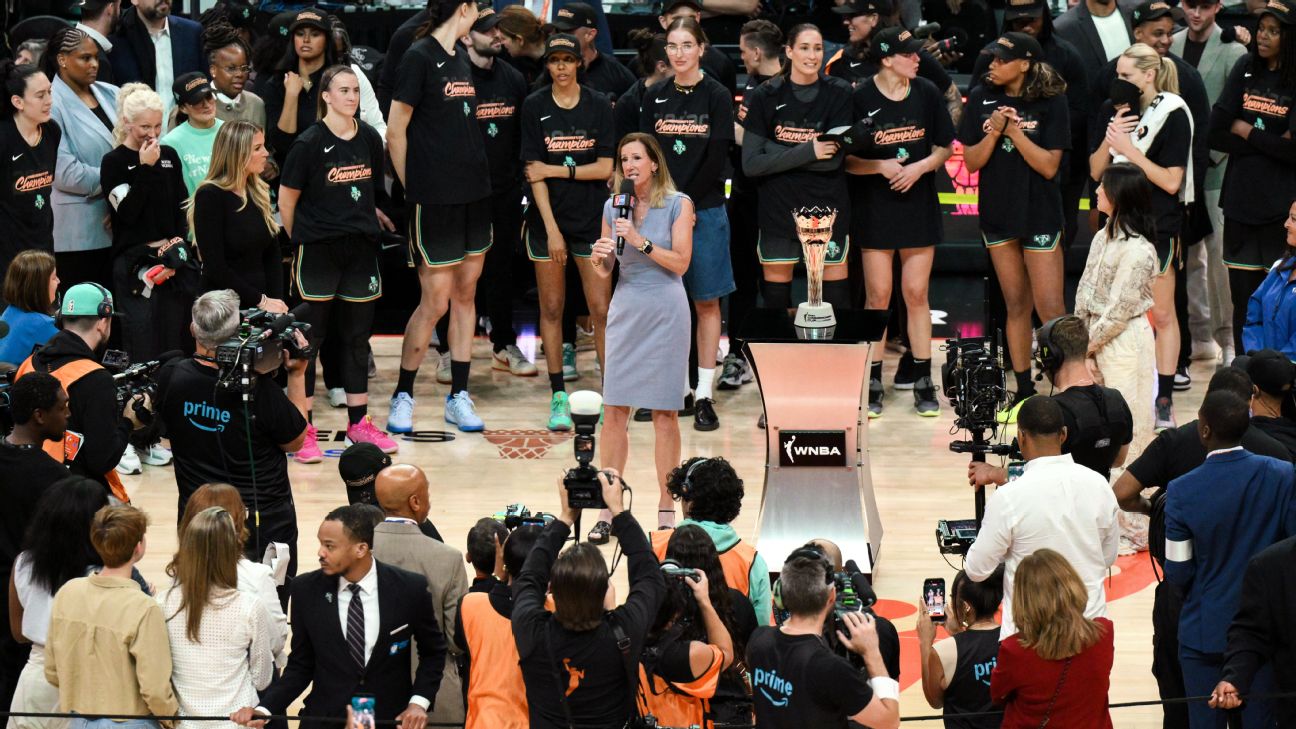
ENGELBERT TRIED TOspeak over the roaring boos that descended upon Barclays Center during the trophy celebration of the Commissioner's Cup championship game late last month. They continued for 30 seconds until she handed the trophy to Liberty owner Clara Wu Tsai. The fan response was so relentless that some players standing behind her looked a little stunned.
Commissioners across pro sports are booed all the time. But since her leadership came into acute focus last year, Engelbert's public reception seems to worsen at each major event.
When asked by ESPN if she's misunderstood, Engelbert paused for a few seconds and almost chuckled before stopping and restarting her answer. "All we're focused on is executing the strategy," she said, referring to her goal of elevating the league from hypergrowth into sustained-growth mode.
She said she wants the attention to be on all that is great with the WNBA and the impact the athletes are having. She insisted that she loves the league, loves the game, loves the players -- "or I wouldn't have taken the job" -- and has always tried to put herself in their shoes and "how tough it is for them to be the best at what they do."
"There's a lot of criticism out there, but you have to block it and go with the strategy that you think is the best to grow these players' brands and the league, and that's what we've done," Engelbert said.
"There's so much good to write about. It's just the biggest frustration I have is that nobody writes about the good parts of the league."
There's plenty of good that can and has been written, from the massive increases in viewership, attendance, merchandise sales, corporate partnerships and team valuations, to the sensational rookie season of Olivia Miles, historic turnaround of Paige Bueckers' Dallas Wings, and A'ja Wilson's quest for a record fifth MVP trophy.
Several team officials pointed out that 10 or 20 years from now, Engelbert's legacy might be viewed favorably, given how she oversaw a new era of growth for the league.
But even those more inclined to defend Engelbert acknowledge it's a different landscape and a job with more complex requirements than what she first assumed in 2019. Some sources speculated that even if she isn't forced out, she might decide she doesn't want to do the job anymore. (When asked in April how much longer she wanted to stay on as commissioner, she responded, "I do crack up how everybody is focused on me. You should be focused on the hundreds of amazing women and thousands of women who run this league outside of myself. ... Nothing else to report, which is probably why Adam didn't report anything. There's no story here.")
"As a business leader at Deloitte, the way she was measured on success there was probably very metric- and business-driven," another team executive said. "The WNBA is a lot more complex and relational. And the amount of different stakeholders that she has to appease between players and owners and front office executives and team presidents and fans, that's not something she's ever had to do."
"I think Cathy's ultimate Achilles' heel will be just relationships, or lack of, with a lot of key stakeholders in the W ecosystem, whether it be owners, presidents, executives, coaches, players, the PA," a different executive said. "In that role, you need to be able to build strong relationships and give and take, and I think she really struggled with that."
Silver has reiterated that he is pleased with where the WNBA is under Engelbert, though he has not addressed her future.
"I think Cathy continues to do a strong job building that league," he said last week after the NBA board of governors meeting. "We'll have ongoing discussions about what the future looks like."
If Engelbert's tenure ends in the near future, there doesn't seem to be an obvious successor within the league office, multiple team executives told ESPN.
"I think people have to be really aware [that] when a person's out of a position of significance like that, there can be a lot of downstream unintended consequences," a different executive said. "So, you have to be sure you're getting it right."
The league has a certain level of guaranteed stability -- the CBA runs through at least 2031, the league's chief media deal with Disney, Prime Video and NBCUniversal goes through 2036 and presumably, there are no immediate plans for expansion beyond 2030 -- but the uniqueness of the WNBA makes managing it exceptionally complex.
The next leader not only needs to better nurture relationships, but also have a stronger leadership presence and more innovative vision to push the WNBA to the next level, league sources told ESPN -- all while operating under the reality that the WNBA operates with nuances no other major league sport faces. The WNBA is still an NBA property with a complicated capital structure and the commissioner reporting to Silver. The league is predominantly made up of Black, LGBTQIA+ women who are often under a microscope.
Even Engelbert's critics acknowledged that these aren't forgiving circumstances and will extend well beyond Engelbert's tenure.
"It's so much more than just being commissioner of a basketball league," the player told ESPN, emphasizing that she feels a lot of issues are more specific to the office than the person. "You're dealing with so many outside voices. You're dealing with sexism. You're dealing with a lot of racism.
"But thoughts and prayers to whoever the next commissioner is. Because that's honestly not a job I would want, and I don't want somebody I know to have it."
ESPN's Ramona Shelburne and Michael Voepel also contributed to this report.br/]