Sophisticated banking spoof callers drain local customers' accounts, nearly fool ABC7 anchor
The calls are from fake banking officials or even fake law enforcement who claim they are protecting your money.


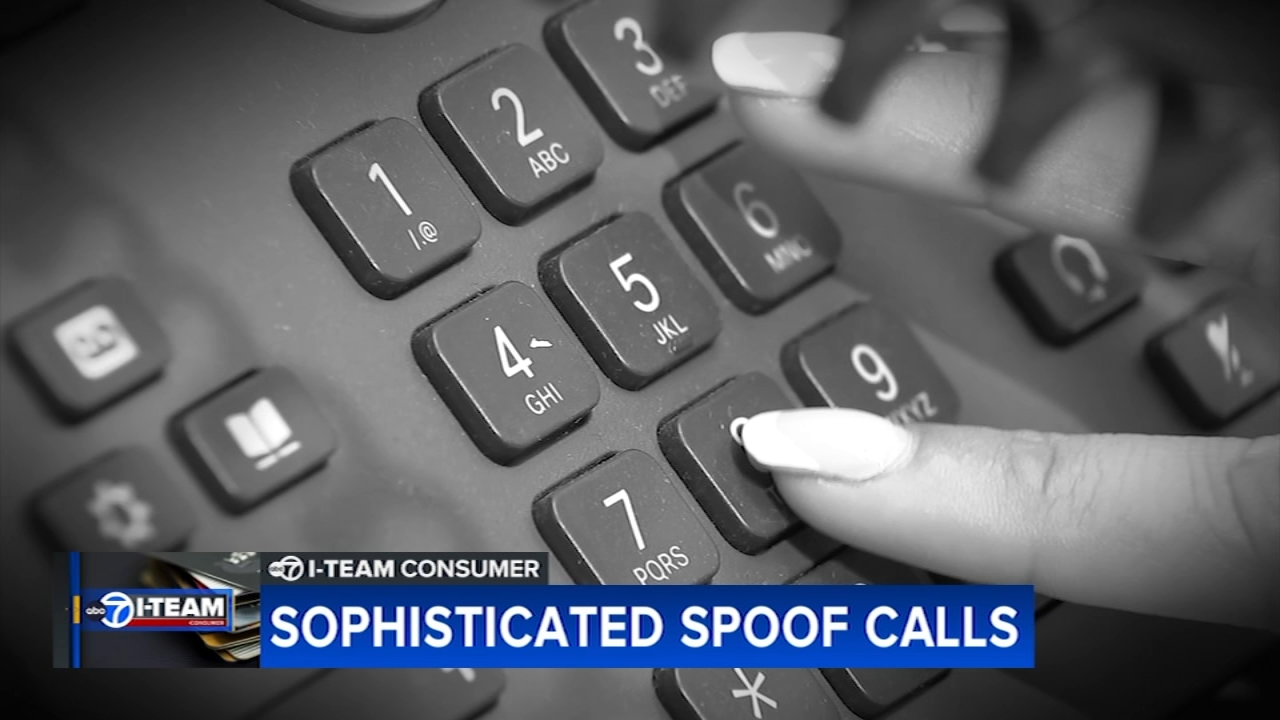
CHICAGO (WLS) -- The ABC7 I-Team is investigating sophisticated banking spoof calls that might fool you into draining your account.
The calls are from fake banking officials or even fake law enforcement who claim they are protecting your money. The FBI calls this a growing problem where people are convinced to move money.
ABC7 Chicago is now streaming 24/7. Click here to watch
ABC7's Rob Elgas decided to tell his story after managing to avoid this spoofing scheme. But many others are losing thousands of dollars.
Northwest suburban Elgin resident Jennifer Lichthardt lost $40,000 from a sophisticated spoof call.
"The first call I got it was the number on the back of my Chase debit card, and it said Chase fraud department," Lichthardt said.
The scammers faking her bank's number said that Chase employees were accessing accounts. They were claiming to be from Chase and even the FBI.
"They read me my account number. They had my account balance down to the penny," Lichthardt said.
The FBI and other experts say criminals can get some banking info from the dark web or even dumpster diving. Once they have that data, they may also be able to call your bank's automated system to get your account balance or transactions.
"They had fake FBI agents that gave me an agent number," Lichthardt said.
They eventually convinced Lichthardt to move close to $40,000 from her Chase account into another a new so-called "secured" Chase account at her local branch and thousands more to another online bank.
Lichthardt says when she realized she was scammed the next morning, she reported the incidents. The money sent disappeared. Chase says that "her funds were withdrawn from the scammer's account the same day" the funds were deposited.
Lichthardt said she felt "financially violated."
Chase added, "We urge all consumers to ignore phone, text, or internet requests to move money or gain access to their computer or bank accounts. Banks and legitimate companies won't make these requests, but scammers will."
"When somebody is calling pretending to be the FBI, the victim then thinks they are in trouble. They are already frazzled, and when they are making these decisions, the criminal then starts to rush them more. The more they are rushed, the more decision-making they make last-minute," said Robert Richardson, a special agent with the FBI Chicago Field Office.
The FBI says in 2025 nationwide, there were more than 191,000 complaints of phishing spoofing incidents, making it the most reported IC3 complaint for the year and adding up to reported losses of more than $215 million.
Huntington Bank customer Susie Allgood received a similar sophisticated spoof call.
"And in order to continue to receive, continue receiving money to and from Zelle, I had to upgrade my Zelle account to a business account," Allgood said. "Because he said he was from Zelle and working with Huntington Bank. So, why would I not believe him? He already had my routing number."
Allgood was convinced to Zelle $5,000 to a fraudster's account to keep her money "safe."
Huntington told ABC7 that customers must acknowledge that they know who they are sending a Zelle to, and that there are multiple scam warnings when sending money through Zelle.
"I think that each case needs to be looked at individually because, did I send the money? Yes, I did. I will admit to that. But I was also instructed by somebody who had the last four of my bank account, had my phone number," Allgood said.
Another similar call from fake Chase reps almost fooled Elgas.
"I talked to them for 34 minutes. They took their time," he said. "It was sophisticated. It really freaked me out."
Elgas nearly Zelled $1,800. He was told that to keep his money "safe," he had to send an "employee FDIC inspector number" through Zelle, but that employee number was really a dollar amount.
"And immediately when I saw the dollar amount in the Zelle payment, I knew I nearly got scammed, this close... Stopped just in time and said, 'Look, you're trying to scam me.' 'No, we're not, sir. And if you if you hang up the phone, we're going to charge the account,' and I said, 'I'm hanging up the phone, I'm going to call Chase.'"
Allgood and Lichthardt reported their crimes to local authorities and the FBI. Lichthardt says federal authorities are helping to track down the criminals.
When asked if she thinks she will get her money back, Lichthardt said, "I don't know. I hope I do. I hope I do."
Chase says it is cooperating with law enforcement.
The consumers in ABC7's story did not get refunds from their banks, because they were scammed and convinced to move money. Banks do cover fraud, like if someone steals your debit card numbers.
A bank will never call you and ask you to send money. When in doubt, call the bank number back on the back of your card.