Federal agencies, US cities on alert for potential retaliatory attacks amid Iran war
No specific information that any individuals, groups or sites in Illinois are being targeted for possible attacks

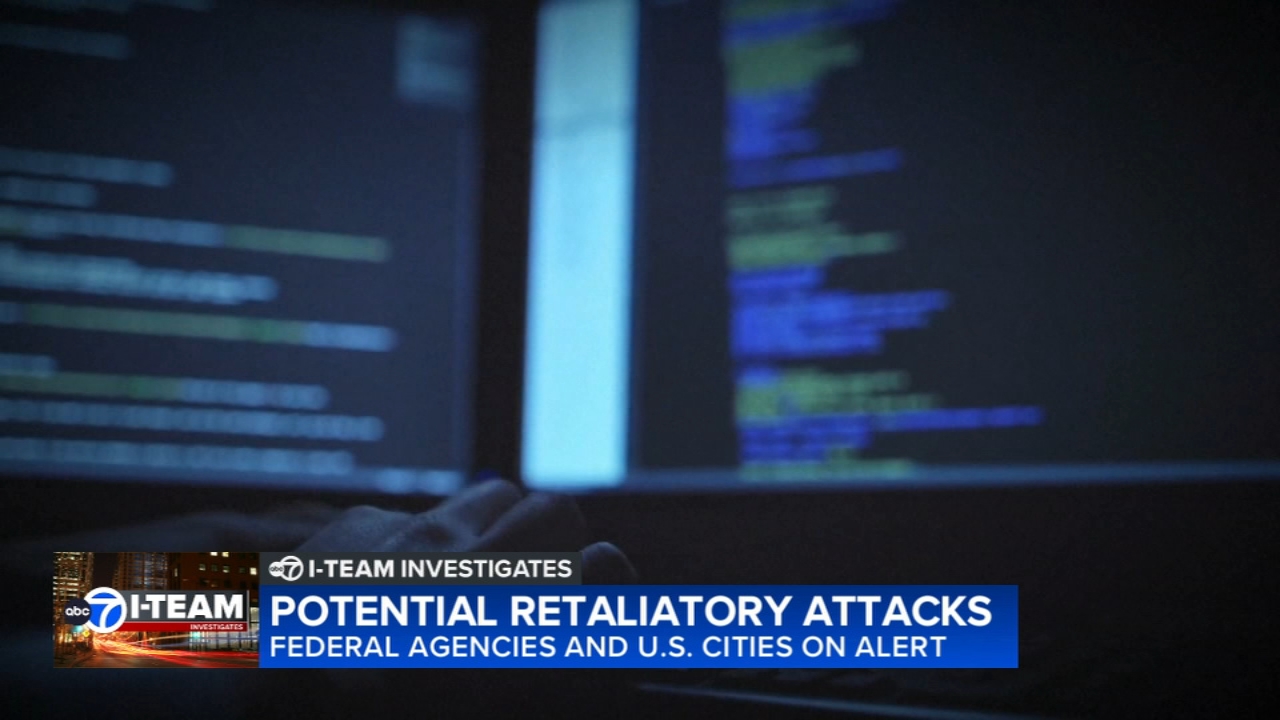
CHICAGO (WLS) -- Following the American and Israeli strikes in Iran, federal and local law enforcement nationwide are on high alert for Iranian retaliation with two main areas of focus: soft civilian targets in the U.S. favored by lone wolf attackers or those influenced by terrorist organizations, and the concern of a repeat cyberattack on critical U.S. infrastructures.
"I think that we can expect Iran to engage in four types of hacks that they've done before: No. 1, go after our banking system; No. 2, hack the systems that underpin our oil supply; No. 3, our critical infrastructure, like water; and finally, mis- and disinformation for our elections. They've done all these types of hacks in the past, and I think we can expect more like them in the future," said Jake Braun, a former senior counselor to the Secretary of Homeland Security, and now head of the Cyber Policy Initiative at University of Chicago.
ABC7 Chicago is now streaming 24/7. Click here to watch
Braun told the I-Team one of his first events for the White House was traveling to Pittsburgh after Iranians hacked a water treatment facility in 2023.
"Our critical infrastructure is quite vulnerable. They look for outdated systems, systems that haven't been patched or are so old that they're not even patched anymore. They're weak spots and an unfortunately, as you accurately point out, those systems are largely what is the back end of so much of our critical infrastructure," he said.
The U.S. has already seen what Iran's cyber capabilities can accomplish: a country known for its ability to sow chaos with a few strokes on a keyboard.
After Operation Midnight Hammer last year, designed to obliterate Iranian nuclear capabilities, Tehran-backed hackers targeted U.S. banks, defense contractors and oil companies.
And, Braun underscored that if they're not, businesses should be on high alert.
RELATED: Chicago woman stuck in Dubai amid US, Israel war with Iran; local Democrats condemn strikes
Jake Cho, a professor of Cyber Security at Lewis University, explained the concern.

"They have new AI weapons. So, the investment to the, for the secure infrastructure, there's no finish. So, we have to assign some certain amount of budget, continuously improve the overall security control. That is only way we can reduce, manage the risk," Cho said.
Cho said that the United States' deep reliance on networked systems for vital industries, like telecommunications, water and power creates efficiency, but remains at risk.
"Any vulnerability in software or formula, in any type of hardware, of course, it can be additional vulnerability," he said
In Springfield, the I-Team has seen firsthand the Statewide Terrorism and Intelligence Center, also known as STIC, working 24/7 to analyze threats, claims of bombs in public places and the ongoing risk from foreign terror groups of domestic lone wolf strikes.
"Iran and its allies have a long history of radicalizing individuals across the world, whether they be in the U.S. or Europe or elsewhere, and encouraging them to take violent action against soft targets in those countries," Braun said
STIC does not have any specific information that any individuals, groups or sites in Illinois are being targeted for possible attacks.
Braun said the federal Cybersecurity and Infrastructure Security Agency, known as CISA, is relaunching its "shields up" campaign, asking individuals and corporations to be hypervigilant as this war with Iran unfolds.