Passan's unique 2026 MLB midseason awards

As the halfway point of the 2026 Major League Baseball season approaches this week, there will be plenty said about the traditional awards. Those are easy: Shohei Ohtani for National League MVP, Jacob Misiorowski for NL Cy Young, JJ Wetherholt for NL Rookie of the Year, Yordan Alvarez for American League MVP, Cam Schlittler for AL Cy Young and Kevin McGonigle for AL Rookie of the Year.
This is a different set of awards. One that seeks out the best ... with a twist. Baseball is not just about players' numbers. It's the stories behind them. This is a celebration of those stories -- though the numbers in the first one are quite telling, too.
Players Are People, Too Award
During spring training, the Kansas City Royals posted a fun video with a supercut of players answering a simple question: How many alarms do you set each day? Most of the players said one or two -- Bobby Witt Jr. doesn't use one because his dog awakens him, and Nick Loftin said, "Just one, discipline," in a judgmental tone -- but the Royals saved the best answer for last.
"This is embarrassing," rookie catcher Carter Jensen said. "But I need at least six to eight alarms. It's not good."
Already an objectively funny capper on the video, Jensen's alarm habits took on particular relevance April 2. Not only did Jensen oversleep, but he overslept on the day of an afternoon game when he was supposed to catch and offer a day of respite for 36-year-old catcher Salvador Perez.
On behalf of everyone who has awoken in a panic, overwhelmed by the crippling feeling of blowing through multiple alarms -- maybe not six to eight, but anything more than three is an impressive feat -- we salute Carter Jensen for setting a new standard of excellence.
50 Cent Memorial Cup
Every year, there are around 2,500 first pitches thrown at major league games -- 2,500 opportunities for people to join a fraternity of ignominy. There are bad first pitches, and then there are bad first pitches. By now, you know the names.
Carl Lewis. Gary Dell'Abate (Baba Booey). Carly Rae Jepsen. John Wall. Cincinnati mayor Mark Mallory. Dr. Anthony Fauci. Victor Wembanyama. Conor McGregor. And, of course, to round out our starting nine, the patron saint of the bunch, rapper 50 Cent, whose left-handed fling at a New York Mets game in 2014 wound up closer to the first-base dugout than home plate.
One would not have expected Miami Dolphins quarterbackMalik Willis to join the list. Unlike the other professional athletes on the list, Willis, you know, uses his arm. And at the beginning, it looked fine: leg lift, internally rotated front hip, front foot toward the target. Willis then made a classic mistake: He tried to throw the ball too hard.
The arm was late. The torso flew open too early. And Willis unleashed a bullet a good 10 feet over the head of Marlins infielder Graham Pauley. The ball ricocheted off the backstop. Willis later posted in the Instagram comments of the Marlins' post on the pitch: "I slipped."
No, you didn't, Malik. You found greatness.
Lufthansa Award
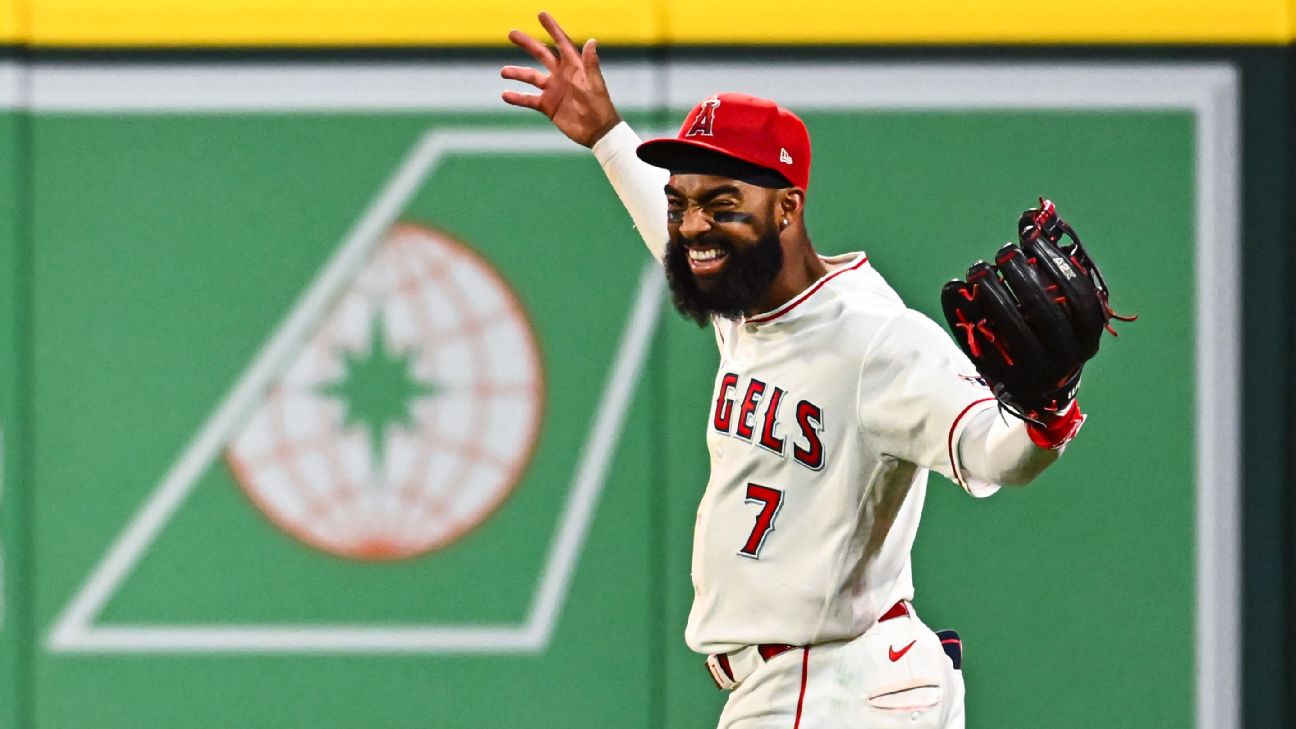
Nobody had robbed three home runs in an MLB game before Los Angeles Angels outfielder Jo Adell engaged in the biggest heist since $5 million cash was stolen from the German airline at JFK airport in December 1978. It wasn't just the number of balls Adell snatched back. The entire scene -- particularly the game state and the visuals -- added weight to its inimitability.
Adell started quickly, backhanding a ball just over the yellow line on a drive to right field by Seattle Mariners slugger Cal Raleigh, the second batter of the game. Los Angeles took a 1-0 lead on a leadoff home run by Zach Neto in the bottom half of the inning, and that score held until the eighth, when Josh Naylor lashed a ball into the same vicinity as Raleigh's ... and had it promptly snatched back by Adell.
If the first eight innings illustrated Adell's capacity for excellence, the ninth enshrined it as an all-time performance. J.P. Crawford yanked a ball down the right-field line. As Adell carefully approached the corner near the foul pole, he stuck his glove over the wall. Incapable of bracing himself because of the angle of his approach, Adell flipped over the wall -- and stood up with the ball in his glove, victorious.
"An out-of-body experience is kind of the best way to describe it," Adell told ESPN. "As I was running over there, I got to the wall a little early, and I knew if I was going to make the play, I was going to be in the stands or I was going to be somewhere within where the fans were for some type of interaction. When I saw the ball pass fair by the foul pole, I leaned over, and before you knew it, I was standing next to three or four guys. I don't know who they are, but they were patting me on the back and, and we were having a great time. And then, shortly after that, that legendary photo was taken from behind."
It's not gauche to call something legendary if it's true. And it is. This is photographic perfection, captured by Kayleigh Kraus, whose framing of the scene -- a big league player in the stands, his feet on concrete cracked by time, left arm extended to the sky, adoring fans yearning to pat him on the back, lights from above shining down on the Angel -- could not be better.
"You don't really see it -- how the video captures it and how the photos capture it after -- and then you go back and look at it, and I'm the one doing it, so my experience is different," Adell said. "I'm just trying to win the game, and then when you come back and look at it, you, the fan, experience it, and people that are watching it, what they experience during the game, and it's kind of cool. It's kind of movie-like, almost."
Unc's Still Got It Award
The days of the age-defying baseball player are at near-extinction levels. Twenty years ago, 22 position players who were 38 or older took at least one at-bat. Fast-forward 10 years, and the number dipped to eight. This year, it's just four, which makes what Paul Goldschmidt is doing that much more remarkable.
Goldschmidt, 38, has been a savior for the New York Yankees' offense this season, turning what was expected to be a part-time role into a consistent spot in the top four of Aaron Boone's batting order. Yes, Giancarlo Stanton and Aaron Judge's injuries precipitated Goldschmidt's ascendance back to regular duty, but it does nothing to lessen its impact.
Not only has Goldschmidt flirted with a .300 batting average -- only 10 players qualified for the batting title are hitting over .300 -- but he has hit more home runs in just over 200 plate appearances (12) than he did last year in 534 (10). How much better has Goldschmidt been than his contemporaries? If you add up the OPS of the other three 38-and-older players, Andrew McCutchen, Carlos Santana and Tommy Pham, it's still less (.887) than Goldschmidt's OPS (.894).
Best Use Of a Traffic Implement
Run differentials in MLB this season show a clean line of demarcation between the top four teams (the Los Angeles Dodgers, Milwaukee Brewers, Yankees and Atlanta Braves) and the remaining 26 teams. The gap between the Braves and the team with the fifth-best differential, the Chicago Cubs, is 76 runs. In that next tier, just behind the Cubs and Seattle Mariners, are the Pittsburgh Pirates.
Don't let the Pirates' .500 record fool you. They've played solid ball this year, with an offense that ranks fourth in runs scored in MLB and a pitching staff with bright spots. (The less said about their defense, the better.) This drive toward postseason contention is mostly a function of good drafting and developing, sure, but the black-and-gold ascent needed a swipe of safety orange to find its truest form.
A quick explanation: During spring training, Fanatics released a T-shirt with a message that made no sense. Underneath an oversized Pirates logo were three words in all capital letters: HOIST THE CONE. It made no sense. When the Pirates win, they "raise the Jolly Roger" -- an homage to flag-flying pirates. But cones? Did Fanatics want to hoist ice cream cones? Pine cones?
After a 1-3 start, outfielder Jake Mangum had a question for a clubhouse attendant in Cincinnati.
"Hey, man, you got any traffic cones laying around?" he asked.
Actually, yes, he did.
"And then, we won that day, and then we just kind of ran with it," Mangum said.
The cone made its way into the dugout and bullpen, and the Pirates hoisted it liberally. Cones started popping up in the stands. And as a complement to the welder's mask hitters wear in the dugout after home runs, the cone reinforced that the Pirates are going full blue collar, an organic way to ingratiate themselves with fans again after years of losses and baseball-free Octobers.
"Home opener at PNC Park," Mangum said. "It was sold out. Unbelievable atmosphere. And then someone pointed out on the downtown skyline, there's cones inside of rooms lit up. The fans are bringing them in. We're signing cones at every game."
Best Bathroom Hygiene
Japanese baseball has delivered wondrous additions to MLB over the past decade. Shohei Ohtani. Yoshinobu Yamamoto. The return of the split-fingered fastball. And the cleanest undercarriages in sports.
For those unfamiliar, Japan is the spiritual home of the bidet, the toilet that uses a stream of warm water to tidy up one's hind parts. If France popularized it and Italy expanded its reach, the bidet was perfected in Japan, which has turned toilets into computerized marvels of cleanliness. They have temperature-controlled seats, built-in air dryers and streams of water that target areas with Madduxian levels of command.
So when Munetaka Murakami joined the Chicago White Sox over the winter, he had one simple request: upgrade your toilets. Toto, the most famous brand of Japanese bidets, offered to help. And thus, a culture was changed: The stink, if you will, of an MLB-record 121 losses in 2024 washed away by a machine spitting 30 psi of power.
When asked about the bidet during spring training, Murakami smiled and said, "Everybody uses too much toilet paper." A home run-hitting, hygienically soundenvironmentalist? What can't Murakami do?
Best Callback to the Attitude Era
The wildest part about Brewers reliever Abner Uribe unleashing three crotch chops while staring into the St. Louis Cardinals' dugout wasn't the thrusts. It was that Uribe found a pitch on the border of the strike zone thrustworthy at all.
The situation: May 26, eighth inning, runners on first and second, the dangerous Alec Burleson at the plate, full count, Brewers lead the Cardinals, 6-0. Uribe, the hard-throwing right-hander, spun a slider that looked like it just clipped the strike zone. Home-plate umpire Adam Hamari rung up Burleson, who challenged the pitch and was greeted by Uribe doing his best D-Generation X impersonation.
The ABS review confirmed the pitch was a strike by 0.2 inches -- about the size of a ladybug. Say what you will about the lack of decorum (MLB suspended Uribe for one game) and the questionable form (he crossed his arms in only one of the three chops). Uribe knows the strike zone. And if you're not down with that, he's got two words for you.
Strike three.
The Terminal Velocity Award
Technically, Misiorowski has not thrown a pitch that reached 105 mph. His 104.5 mph heater to Kyle Schwarberwas rounded up. Nobody doubts he can reach 105, though. Misiorowski, the National League Cy Young favorite, is setting all sorts of standards for pitch velocity in his first full big league season. The most notable include:
- Pitches at 101.0 mph or harder: 332, the most of any starting pitcher. Though Misiorowski has a ways to go to catch the gold standard for velocity, Boston closer Aroldis Chapman-- with 2,236 at 101 plus since pitch-tracking started in 2008 -- Misiorowski is averaging 100.3 mph on his fastball, more than 2 mph ahead of the starter with the second-highest average velo, Chase Burns
- Pitches at 102.0 mph or harder: 146 -- more than the combined number of every other pitcher in MLB (115)
- Pitches at 103.0 mph or harder: 49, which, considering he's the only starter in the pitch-tracking era to exceed 103, might be the most impressive of all. Chapman has 308 in his 16-year career
- Pitches at 104.0 mph or harder: 6 -- all of the 104-plus offerings in the big leagues this season -- out of the 1,370 fastballs he has thrown. Misiorowski has a ways to go to catch Chapman's all-time record of 70.
The time is coming. The 105.8 mph record Chapman set for an individual pitch in 2010 -- is in Misiorowski's reach.The All-Star Game, where Misiorowski can let it rip for just one inning, is three weeks from today.
Best Little League Home Run
Little League home runs are the best. Nothing beats the combination of a mistake leading to a mad dash toward home plate. Even if they are definitionally not home runs -- every Little League homer involves an error, and if it doesn't, it's an inside-the-park home run -- they bring the same sort of joy and exhilaration. Imagine, then, a Little League home run and another of the most exciting plays in baseball rolled into one.
That's what happened May 19. Arizona Diamondbacks outfielder Corbin Carroll is the undisputed king of the triple in MLB, notching 50 since his first full season in 2023. (Next on the list: Boston outfielder Jarren Duran at 31 since 2023). Carroll sliced a ball into the cavernous left-center gap at Chase Field and turned on the afterburners. As Carroll rounded first, his batting helmet flew off, often a sign he's looking to go from home to third, which he has done in less than 11 seconds. As Carroll slid in feetfirst, the relay throw from San Francisco second baseman Luis Arráez was on-target. A little too on-target, actually. It nailed Carroll in his unhelmeted head.
"Would not recommend. Definitely would not recommend," Carroll said. "I didn't know he had that in the tank. ... I was fully prepared to just sit on that base for the next five minutes, but our third-base coach kept yelling at me, so had to get up and run."
Up he got and off he ran, with the carom off Carroll's head far enough that there wasn't a play at home. One can forgive Carroll for not celebrating in the aftermath.
"I didn't feel great for the rest of that game," he said. "I won't lie. I kind of just sat on the bench and didn't talk to anyone. That was ... yeah, again, would not recommend."
Worst Bone
This was a tough one. Not only have bone chips sidelined Hunter Greene, Blake Snell, Edwin Díaz, Spencer Schwellenbach, Hurston Waldrep and Carlos Rodón at points this season, butTarik Skubal's were also removed using new NanoScope technology that halved his return time.
There is no such hope for hitters who break their hamate bone, a small, hook-shaped node of fragility in the hand. Hamate injuries are almost always caused by the knob of the bat, around which some hitters wrap their hand, with the force of the ball meeting the bat sometimes enough to reverberate into the hand and crack the bone. The recovery is often slow, and the results -- sapped power -- are frequently problematic.
Early in spring training, Carroll, Francisco Lindor and Jackson Holliday broke their hamates on the same day. Since then, Ryan Jeffers and Vinnie Pasquantino have gone down, and Jose Ramírez broke his for a second time.
Rare is the double hamate break. It's almost impossible to break a hamate bone twice because the fracture typically occurs at the junction of the hook, and surgery is done to remove the fragment. In Ramírez's case, however, there was one difference: He's a switch-hitter. Ramírez fractured his right hamate in August 2019 and his left less than two weeks ago. He's expected to be out until August.
Best Innovation
Just as with the pitch clock in 2023, the Automated Ball-Strike Challenge system debuted this year to immense fanfare and significant questions that soon dissipated. If the pitch clock is the No. 1 innovation in sports over the past half-century, ABS might be 1a. It solves a problem in an unobtrusive, speedy, aesthetically pleasing way. The downsides to it are scant. It's another big win for baseball.
What's especially fun is that with enough data points now, we're beginning to get a sense of teams' philosophies regarding challenges. Minnesota's is simple: challenge a lot. (The Twins' 212 challenges in their first 79 games were 25 more than the A's, the next-highest team.) The Twins have also been the best at it, in terms of runs gained by challenge against what's expected, with 4.7, according to Statcast. With about 10 runs equaling one win above replacement, the Twins are on pace to earn a win through ABS alone. Others in that same realm: Colorado (4.2 runs) and the Yankees (4.0).
Milwaukee and Miami have quite clearly told their hitters that the challenge system strongly favors catchers, and both teams are spending nearly 70% of their challenges on the defensive side. Baltimore, on the other hand, has the highest rate from its hitters at 56.5%.
And then, there are the teams that don't challenge much: Arizona (126), Boston (127) and Texas (132). All three are in the negative in runs gained vs. expected, as are 11 of the 12 teams with the fewest challenges. Maybe teams that are bad at challenging are bad regardless of the number of times they do it. But almost all the best -- the Los Angeles Angels are the rare exception -- are the ones that use the system the most.
Worst Wardrobe Malfunction
Here's a riddle: How can a player hit a ball that doesn't go over the wall, never touches the ground and still is a single?
The answer: hit it inside the pitcher's jersey.
That happened April 22, when A's outfielder Carlos Cortes smashed a 107.8 mph rocket back up the middle -- and it went inside the uniform of Seattle Mariners right-hander Logan Gilbert.
"It was all a blur," Gilbert said. "It was pretty scary, honestly. You don't see the ball coming the whole way. You just see like a flash or two, and then, all of a sudden, it hits you. The game wasn't going great already, so I'm not very happy to begin with. Then, he just laces a ball right at me. Somehow went inside my jersey. I still don't know how. Didn't get the out, either, which -- I don't know how that works. Not that I earned it by any means, but the ball didn't touch the ground."
This ... is a fair point. A batted ball that hits a runner can be ruled a single, but it's at the scorer's discretion. In this case, home-plate umpire Alfonso Marquez knew the rule: He immediately put his hands in the air and pointed to first base, awarding it to Cortes even though Gilbert technically caught the ball.
"Anybody can catch it in the glove, right?" Gilbert said. "It's kind of outdated a little bit. I tried to mix it up a little bit and got no style points for it."
The Golden Doink
There haven't been any otherworldly home runs, by distance alone, this season. Atlanta catcher Drake Baldwin hit a ball 473 feet a week ago. Five A's have hit 460-foot-plus homers. Schwarber regularly hits moonshots, but none this season has traveled more than 460 feet.
The most impressive homer of the year went a projected 432 feet. It was the hardest-hit homer this year, at 116.9 mph, but that's not the best part of Oneil Cruz's wallop in Texas on April 22. Cruz took a middle-middle Jalen Beeks cutter and yanked it down the right-field line. The only question was whether it would stay fair, which it did in incredible fashion.
The ball doinked off the top of the 92-foot foul pole. Not "the top" as in inches from the highest point. It actually bounced off the flat, circular tippy-top of the pole, leaving a mark -- not because of the incredible velocity of the home run but because the top of foul poles in domed stadiums can get very dusty, and there's now a baseball-sized circle on Globe Life Field's.
The combination of elements for this to happen -- massive human being who can hit a ball down the line at the exit velocity and trajectory that allow it to bounce off the pole, plus the random luck it took to travel the precise path necessary -- is as seemingly impossible as hitting a ball such that it winds up in a pitcher's jersey. That's baseball, though. A game where the impossible is one swing away.br/]
Related Topics
- SPORTS
- ESPN
- MANGUM JAKE
- MLB
- CHICAGO WHITE-SOX
- KANSAS CITY-ROYALS
- GOLDSCHMIDT PAUL
- NEW YORK-YANKEES
- ARIZONA DIAMONDBACKS
- GILBERT LOGAN
- CRUZ ONEIL
- PITTSBURGH PIRATES
- MURAKAMI MUNETAKA
- ADELL JO
- CARROLL CORBIN
- ATHLETICS ATHLETICS
- SEATTLE MARINERS
- LOS ANGELES-ANGELS
- MILWAUKEE BREWERS
- MISIOROWSKI JACOB
- JENSEN CARTER
- URIBE ABNER