What's gone wrong for the Cubs -- and if they can fix it
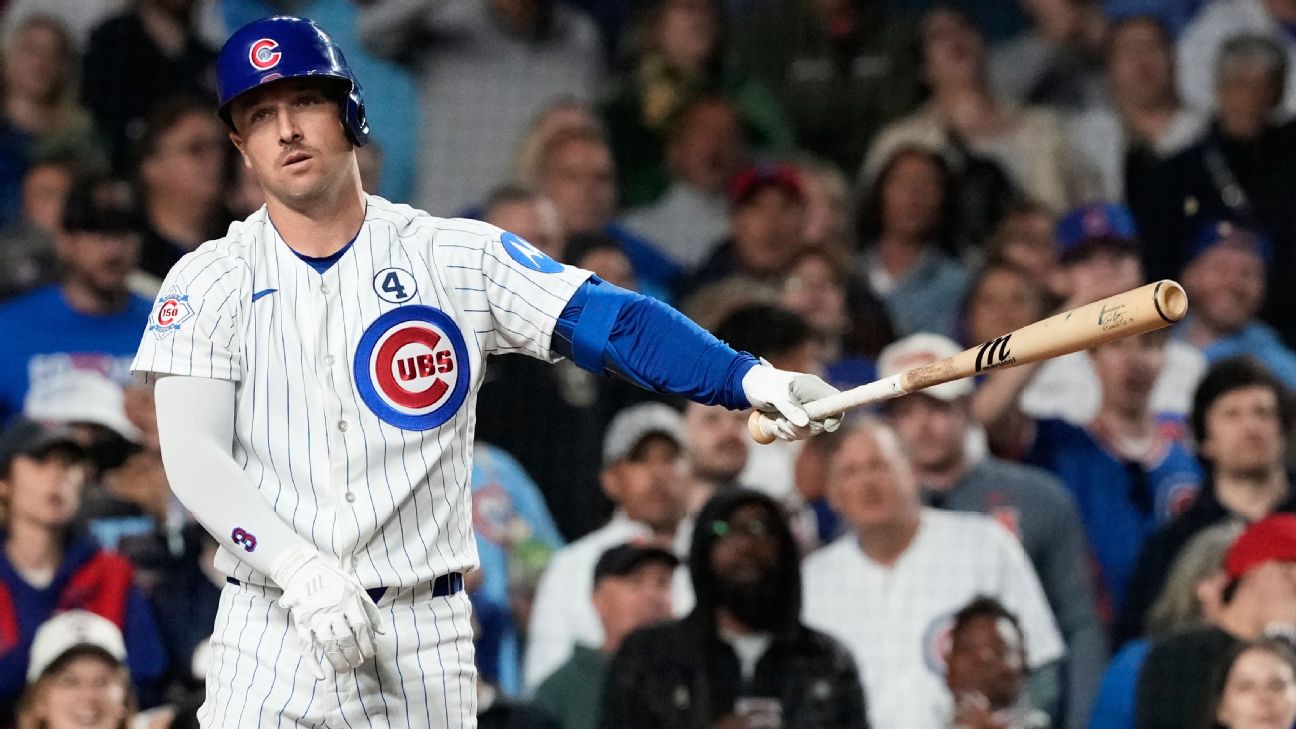

Just over a month ago, everything seemed to be clicking for the Chicago Cubs.
The offense was wearing down opposing pitching staffs with its depth. The defense was taking away would-be hits from opposing hitters. And despite some early injuries, the rotation was still getting the job done. It all added up to a 27-12 start and a perch atop the National League Central.
Then it all came crashing down.
Chicago's bats went quiet and injuries finally took their toll on the pitching staff and, suddenly, the Cubs had traded in their division lead for a spot in the basement.
After dropping the first two games of a series in Colorado this week, the Cubs became the earliest team by the calendar to fall to .500 after being 15 games over in a season, according to ESPN Research. Only the 1996 San Diego Padres have come close, but after a 35-20 start, the Padres fell back to .500 in late June. The Cubs did it on June 10.
Veteran pitcher Jameson Taillon was asked if doubt has crept into a once confident and vibrant locker room.
"I don't know about doubt," the injured starter answered. "We all know what we're capable of still. It's a matter of 'What's it going to take to get us back to being a good team?' I don't doubt we can be that good team. That being said, it would be nice to see it soon."
Now that Chicago has won consecutive games for the first time since May 28, is the team that had Chicago abuzz just over a month ago due to return to that form? Or has this case of whiplash brought with it a wider realization -- that the 2026 Cubs are just not good enough?
Let's examine the topics that will decide where the season goes from here.
Watch Cubs-Giants, Sun. at 3 p.m. ET on ABC
The offense
From Opening Day through May 8, the Cubs had the highest scoring offense in baseball at 5.51 runs per game. Since then, they've scored a paltry 3.4 times per game -- good for 29th in the sport over that timeframe.
Chicago's biggest offseason splash, Alex Bregman, recently shouldered the blame for the lineup's swoon after posting a .686 OPS and career-worst 16.7 strikeout rate over his first 68 games with the team.
"I haven't executed all year," Bregman said last week. "Runners in scoring position, I've been god-awful. I need to be better. If I'm better over the last how many games, we probably win the majority of them... They brought me here to play good baseball, and I haven't played good baseball. I need to figure it out."
While Bregman's meager production is not what the Cubs had in mind when they signed the 32-year-old infielder to a $175 million deal last offseason, he is not the only star in Chicago's lineup who isn't getting the job done at the plate.
Shortstop Dansby Swanson was benched for a couple games earlier this week as his offensive woes continue to mount. Of 158 qualified hitters, Swanson's .178 batting average is the second lowest behind only San Diego's Manny Machado. Second baseman Nico Hoerner is hitting under .200 since May 8 after a hot start to the season, and Matt Shaw and Moises Ballesteros have struggled to find consistency while being shuffled in and out of the lineup.
"The backbone of our team is our position players," Cubs president Jed Hoyer said. "They have to play well for us to be a good team."
If the Cubs are going to turn it around, they know it starts with getting power from all over the lineup -- just as they did a season ago. Since their ride to the bottom of the standings began on May 8, Cubs hitters rank just 23rd in the sport in home runs, and their four home run leaders from last season (along with Bregman) are all on pace for fewer long balls.
"Michael Busch hit 34 home runs last year," Hoyer said. "Pete [Crow-Armstrong] hit over 30. Seiya [Suzuki] hit over 30. Ian [Happ], Dansby in the 20s. Bregman should hit homers. Our guys that hit homers are not hitting homers and ultimately that is the challenge."
The Cubs are also seeing many more breaking pitches during their slump, from 33% early in the season to 37% over the last month. That's led to a collective higher launch angle -- 13.9 degrees to 16.9 -- as those pitches create loft, in part, because hitters are getting out in front of the ball.



"A lot of it has to do with some of the sliders and breaking balls we've seen and the uptick in change ups," Cubs hitting coach Dustin Kelly said. "I don't want super high launch angles. I want line drives in the gap, but no, guys aren't selling out."
The importance of collective production from up and down the lineup is heightened because even when things are going well, the Cubs don't feature the type of superstar hitter who can carry their offense for weeks at a time like some teams atop the standings do. Think Aaron Judge for the New York Yankees, Shohei Ohtani for the Los Angeles Dodgers or even another top slugger the Cubs got a firsthand look at last week.
"There is no doubt, watching [Athletics first baseman] Nick Kurtz in that series, that is a superstar middle-of-the-order bat, and every time he's up, if you're a fan, you can't look away, and if you're me, you're hoping for a good result," Hoyer said. "I don't think we have that kind of middle-of-the-order slugger. There's not a lot of those guys out there.
"But we have one of the deepest offenses in baseball. Period."
The rotation
Getting the best version of that deep offense is paramount, because while many of Chicago's lineup problems have potential solutions, the Cubs are running out of options to fix their pitching issues. Rival scouts and execs point to the team's mounting injuries and lack of pitching depth as the long-term issues that could ultimately sink the Cubs.
"Even during their 10-game losing streak, which was mostly because of a lack of scoring, it never felt right on the mound for them," one scout said.
Long before that skid, injuries first hit the rotation when budding star Cade Horton was lost for the season on April 3. Veteran left-hander Matthew Boyd hit the injured list with a knee injury a month later and suffered a recent setback when he started experiencing shoulder soreness that will delay his return. Then Taillon went on IL this week with a hamstring strain that leaves the Cubs without 60% of their Opening Day rotation.
The two remaining members of that group -- Shota Imanaga and Edward Cabrera -- have also struggled over the past month. Imanaga finally offered some reason for optimism with five scoreless innings in Colorado after allowing 26 runs over his previous four starts and Cabrera, likewise, pitched well against the Rockies after allowing eight runs over 3 innings against the Giants on June 5.
All told, the Cubs' starting staff ranks only ahead of the Rockies in ERA in the NL while giving up an MLB-high 67 home runs.
There has been one clear bright spot though: right-hander Ben Brown, who has posted a 1.44 ERA over six starts since being moved into the rotation from the bullpen. But the 26-year-old who has made just 29 career starts isn't going to carry the rotation by himself, and the question remains who is going to step up to help Chicago climb back up the standings.
What it means for the trade deadline
One thing should be clear to the 26 players in the Cubs' clubhouse right now: The trade deadline isn't going to solve their problems for them -- especially in the lineup.
Hoyer recently said that the deadline is "the furthest thing from my mind" while also acknowledging that help on the mound will be their trade focus over adding an impact bat.
"Our position player group is deep, and it's pretty set," he explained. "We'll be looking at pitching at that point. [But] sitting here talking about the deadline, given how we've played, is the wrong thing to talk about."
The much more pressing topic is if the Cubs can start stacking enough wins to give their front office a reason to make a splash at the deadline. According to FanGraphs, the Cubs' playoff odds have fallen to 43.8% and with the Brewers distancing themselves at the top of the NL Central, Chicago's division odds are down to 6.9% with only a 1.6% chance of earning an opening-round bye.
"Your World Series odds are probably going to be correlated to your odds of getting a bye, and getting a bye is such a big deal," Hoyer said. "A lot of that aggressiveness is based on that ability to get the bye."
But Hoyer also maintains it is too early to say goodbye to the Cubs' hopes in 2026 completely.
"Sometimes when you're winning, winning kind of finds you," he said recently.
And, as Chicago has found out over the past month, sometimes it's the opposite.br/]