Judge orders feds to preserve videos of agents using tear gas; ICE says some footage likely erased
The judge ordered depositions of CBP's Gregory Bovino, ICE's Russell Hott, and CBP Deputy Chief Patrol Agent Daniel Parra.
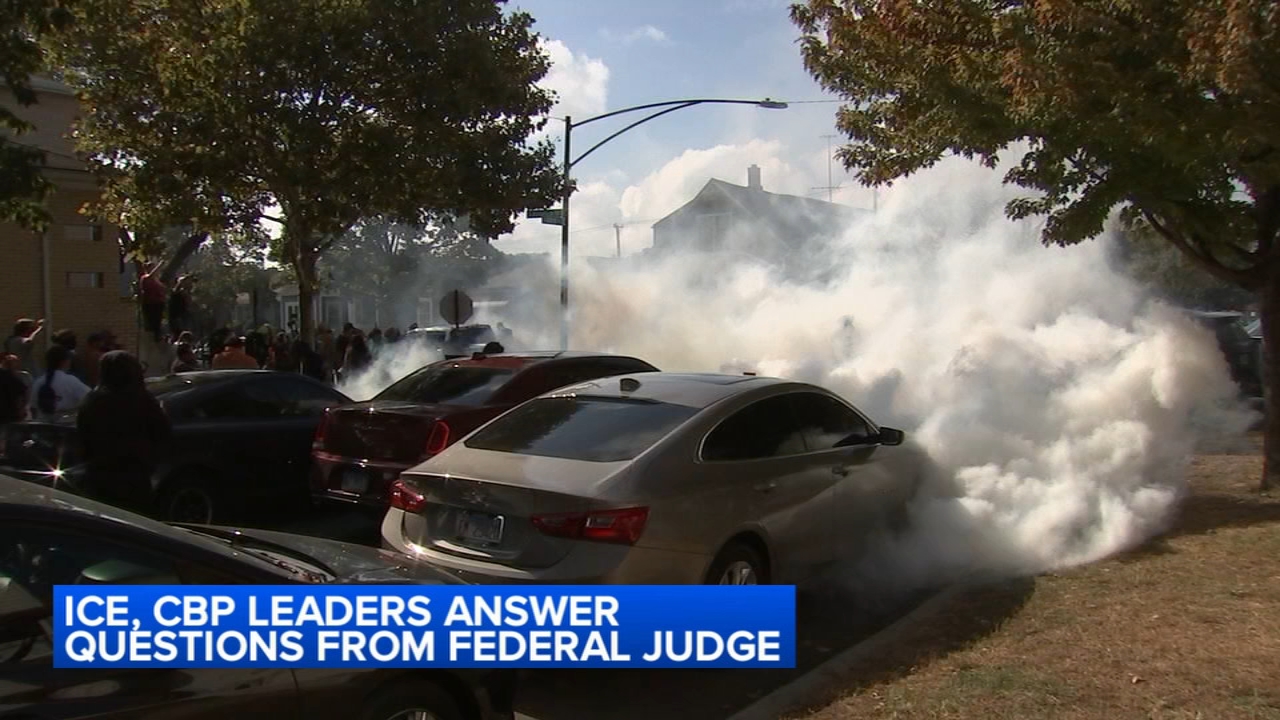

CHICAGO (WLS) -- A judge on Monday ordered the government to preserve all video evidence that shows federal immigration enforcement agents deploying tear gas and other chemical agents toward Chicago-area protesters, members of the media and others since the beginning of the Department of Homeland Security's immigration operation "Midway Blitz."
But on the stand Monday, the second-in-command of Chicago's Immigration and Customs Enforcement field office said any footage, at least from Broadview's ICE processing facility, recorded before Sept. 18 has likely already been erased.
ABC7 Chicago is now streaming 24/7. Click here to watch
District Court Judge Sara Ellis order came as representatives from both ICE and Customs and Border Patrol testified before her at the Dirksen Federal Courthouse on Monday about recent protests and the use of tear gas in the Chicago area.
"If there hasn't been a preservation order given, it needs to be given," Ellis said.
For hours, Ellis questioned officials at the heart of the government's immigration enforcement operation in Chicago. She asked them to explain their agencies' policies and tactics regarding use of force, body-worn cameras, and proper methods of identification.
SEE ALSO | Chicago federal intervention: Tracking surge in immigration enforcement operations | Live updates
CPB Deputy Incident Commander Kyle Harvick and ICE Deputy Field Director Shawn Byers both said to their knowledge, none of their agents have been disciplined in relation to any of the well-publicized deployments of tear gas and pepper balls against people and protesters across the city in recent weeks.
This comes after Ellis, last week, accused federal agents of violating the temporary restraining order she'd issued a week earlier in response to a civil rights lawsuit filed Oct. 6.
"We take these TROs very seriously. These are your orders," Harvick said.
But during Harvick's testimony, he provided the agency's justifications for deploying tear gas in both the Oct. 12 Albany Park arrest and Oct. 14 East Side pursuit-turned-arrest-turned-protest incident.
"The longer we are there, and others come and become assaultive, the situation becomes more and more dangerous," Harvick said.
Harvick also said, contrary to multiple reports from witnesses, that warnings were issued before tear gas was deployed.
For Albany Park arrest, Harvick said he reviewed body-camera footage from two officers on the scene that day, and a supervisor that arrived on scene determined tear gas should be deployed as members of the public were "linking arms" and surrounding the agents after they arrested someone, preventing them from exiting.
For the East Side incident, Harvick said he did not review any body-camera footage, but "he was told warnings were given." He said that officers determined to deploy tear gas after objects, including an egg, brick and "metal object," were thrown in their direction.
ABC7 Legal Analyst Gil Soffer said nothing has changed with the judge's ruling.
"The TRO remains in effect and the next stage is a preliminary injunction hearing which is a mini trial of sorts where there will be testimony, arguments and a fuller discussion of all the issues we've seen so far," Soffer said.
Under questioning from Ellis, Harvick said that all CBP agents are trained in basic crowd control procedures and some agents have more advanced training, but he said that there had not been any specific crowd control training to prepare for the deployment to Chicago. All agents, he said, are trained quarterly on use-of-force.
Ellis also inquired specifically about the practice of agents wearing face and head coverings during enforcement activity. Harvick said that some agents wear them as some protection from cold weather or from breathing in gasses; he acknowledged that "mostly it's for doxxing cases that we have experienced for agents or their families."
Harvick also testified that the requirements of the temporary restraining order Ellis issued, including the modification about body cameras, has been relayed electronically to all agents, and discussed during morning roll-call meetings.
In accordance with the TRO, Harvick said, all CBP agents have been instructed to display somewhere on their uniform an identifying number. In some cases, agents have written their number on a piece of duct tape and stuck it on the uniform's shoulders.
Harvick also testified that all agents working under operation "Midway Blitz" have been assigned body-worn cameras. He also said there are 201 Border Patrol agents in the Chicago area, including command staff. The number does not include ICE agents.
Harvick said CBP officers are required to wear and keep cameras on and recording during enforcement activities.
Byers was also on the defensive during Monday's hearing. The courtroom sketch artist blurred his face at the judge's request.
Byers said that both ICE and CBP are conducting immigration enforcement via operation "Midway Blitz" "independently but parallel" and that no one person or agency is overseeing the entire operation. He said the total number of ICE agents in the Chicago Area of Responsibility, which includes Illinois and five neighboring states, is around 300. Around 85 serve the Chicago city area.
Byers said ICE agents in the Chicago area do not have body-worn cameras, and it would require Congress to reauthorize funding for that to happen.
Byers also responded to questions regarding agents' use of force against protesters and others at the ICE processing facility in Broadview, while also washing his hands of CBP's actions across the city.
"We're still doing targeted enforcement... They do it a little bit differently, as everybody has seen," Byers said.
Byers said that both ICE and CBP are conducting immigration enforcement via operation "Midway Blitz" "independently but parallel" and that no one person or agency is overseeing the entire operation.
Byers said the raid on the South Shore apartment was done by CBP, not ICE.
Regarding the Sept 19. incident of the Rev. David Black being shot in the head by a pepper ball, Byers said he had reviewed surveillance footage from the Broadview facility of that incident and that the complete narrative has not been shared publicly. He said he heard agents give several warnings before shooting, and Black ignored those commands.
Byers said on the stand that due to "server issues," surveillance footage from the facility prior to Sept. 18 has likely been overwritten and is no longer available. Byers needs to confirm that footage of Black being shot has been preserved.
During Monday's hearing Ellis granted the plaintiffs' request that they be able to depose three federal law enforcement officials about operation "Midway Blitz" in advance of a preliminary injunction hearing scheduled for next month.
Ellis ordered depositions, limited to two hours, of CBP's Gregory Bovino, who is commanding the agency's operations in Chicago; ICE's Russell Hott, who, until Friday was directing field operations in Chicago; and CBP Deputy Chief Patrol Agent Daniel Parra.
The plaintiffs in the case are a coalition of journalists, religious leaders and civic organizations.
Meanwhile, community meeting was held in Lakeview on Monday night to discuss the federal action, and inform residents of their rights.
Illinois' Fifth District Congressman Mike Quigley doubted the sincerity of the Trump administration's enforcement activity.
"This is not about keeping us safe. This is not about keeping us secure. It is about scaring people," Quigley said.
And civil rights activists say the courts remain a bulwark of the rule of law.
"When the courts get a chance to delve into these questions, to pull them apart and look at the administration's reasoning, the administration doesn't do very well" said Ed Yohnka with the ACLU.
ABC News contributed to this report.